



Why Do Tissue Jumbo Roll / Parent Roll Quotes Require Paper Weight, Ply Count, and Roll Width Specifications?
A Complete Guide for Tissue Paper Importers and Converters
1. Introduction: The Question Every Buyer Asks
If you have ever reached out to a tissue jumbo roll supplier for a freight or product quote, chances are you have asked one of the following questions:
“How many tons of tissue jumbo rolls can fit in one container?”
“How many rolls can you load into a 40-foot container?”
These are completely reasonable questions — and as your supplier, we genuinely want to answer them quickly. But here is the challenge: without knowing three specific details about your product requirements, any number we give you would be an educated guess at best, and dangerously misleading at worst.
Those three details are:
- Paper Weight (GSM — Grams per Square Meter)
- Number of Plies (Layers)
- Roll Width (in millimeters)
This article explains exactly why these three variables are non-negotiable for generating an accurate quote — and how understanding them will make you a more confident, more efficient buyer of tissue jumbo roll.
2. What Is a Tissue Jumbo Roll (Parent Roll)?
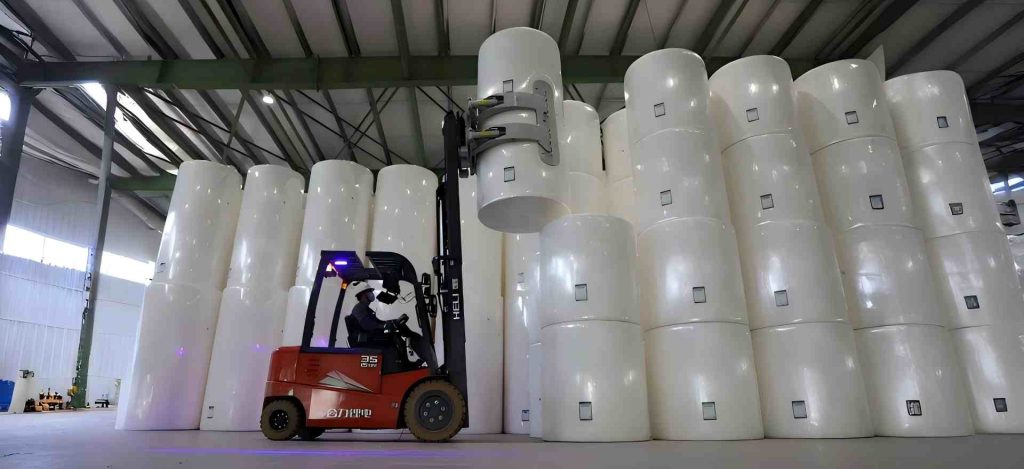
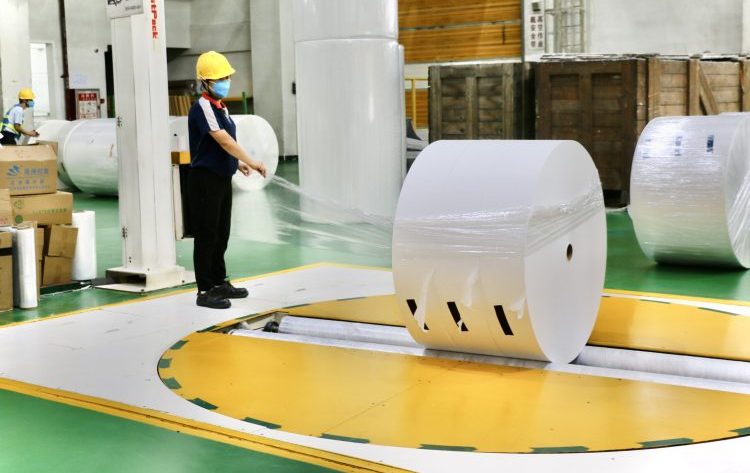
Tissue jumbo rolls — also called parent rolls or tissue parent rolls — are the raw material used by tissue converters around the world. They are massive cylinders of paper that are later fed into converting machines to produce finished consumer products such as toilet paper, facial tissue, paper napkins, kitchen towels, and bottom-pull dispensing tissue.
At Yuanhua Paper, our jumbo rolls are manufactured from 100% virgin wood pulp, offering excellent softness, strength, and hygiene properties. Our products cover a GSM range of 12 to 42 gsm and can be produced in 1-ply to 5-ply configurations.
Here is the critical point that every buyer needs to understand:
| KEY INSIGHT: What Is Fixed vs. What Is Variable in a Jumbo Roll FIXED: Roll outer diameter — approximately 1,150 mm (this is determined by our production machinery) VARIABLE: GSM (paper weight) — changes the weight of every roll VARIABLE: Number of plies — multiplies paper thickness and total weight VARIABLE: Roll width — determines how many rolls fit side by side in a container
The container dimensions are also fixed. This means the number of rolls and total tonnage per container depends entirely on the three variables above. |
Because the diameter is fixed but weight and physical dimensions vary so dramatically across product specifications, the same container can carry a completely different quantity of product depending on what you order. This is the core reason why your supplier always asks for these details.

3. The Three Key Specifications — and Why Each One Matters
3.1 Paper Weight (GSM — Grams per Square Meter)
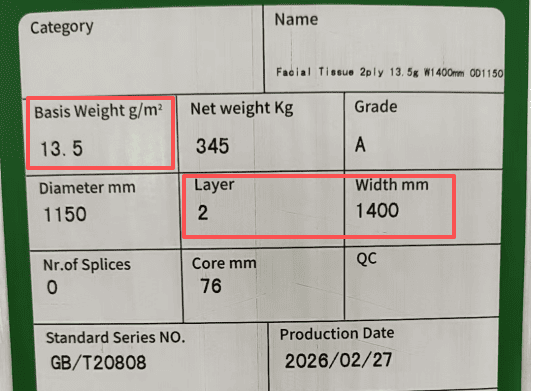
GSM stands for Grams per Square Meter. It is the universal measurement of paper density — how much a single square meter of the paper weighs. In the tissue industry, GSM is one of the most fundamental specifications because it directly determines the weight of every roll produced.
Common GSM ranges and their typical applications in the tissue industry are as follows:
| GSM Range | Typical Application |
| 12 – 16 gsm | Ultra-lightweight single-ply tissue; industrial dispensing tissue |
| 17 – 22 gsm | Standard toilet paper, facial tissue, economy napkins |
| 23 – 30 gsm | Premium toilet paper, premium facial tissue, soft-touch napkins |
| 31 – 42 gsm | Thick multi-ply tissue, heavy-duty kitchen towels, specialty products |
Why does this matter for container loading? Consider two rolls with identical 1,150 mm diameters and identical widths. A roll at 14 gsm might weigh 400 kg. The same-sized roll at 30 gsm could weigh 850 kg or more. That is more than double the weight — from a roll that looks exactly the same from the outside.
Containers have both a volume limit (how much physical space is available) and a weight limit (the maximum payload, typically 21–26 metric tons for a 20-foot container, 26–28 metric tons for a 40-foot container). Depending on your GSM, your shipment may hit the weight limit long before the container is physically full — or it may fill the space before approaching the weight limit. Without knowing your GSM, we cannot tell which constraint applies to your order.
3.2 Number of Plies (Layers)- Paper PLY
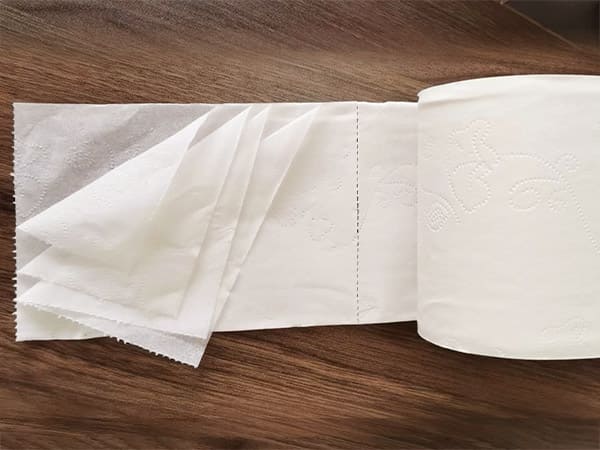
“Ply” refers to the number of individual layers of tissue paper that are bonded or wound together in the final roll. A 1-ply roll contains a single layer; a 2-ply roll contains two layers bonded together; and so on up to 5-ply for specialty products.
Ply count has a direct and compounding effect on roll weight. Here is why: when you wind multiple layers of tissue simultaneously onto a roll of fixed diameter, each revolution of the roll adds the thickness of all plies at once. This means a 2-ply roll at 14 gsm per layer is effectively equivalent in weight to a 1-ply roll at 28 gsm. The roll reaches the same diameter with far more paper mass inside it.
The practical impact on container loading is significant:
- A 1-ply roll at 14 gsm per layer may weigh 400 kg
- A 2-ply roll at the same 14 gsm per layer may weigh close to 800 kg
- A 3-ply roll at 14 gsm per layer may weigh over 1,100 kg
The number of rolls you can fit per container changes dramatically based on whether you are shipping 1-ply, 2-ply, or 3-ply product. A supplier who gives you a roll count without knowing your ply specification is essentially giving you a number pulled from thin air.
3.3 Roll Width (Millimeters)
Roll width is the measurement along the axis of the roll — in simple terms, how wide the roll is from one flat end to the other. This is different from the diameter, which measures how big around the roll is.
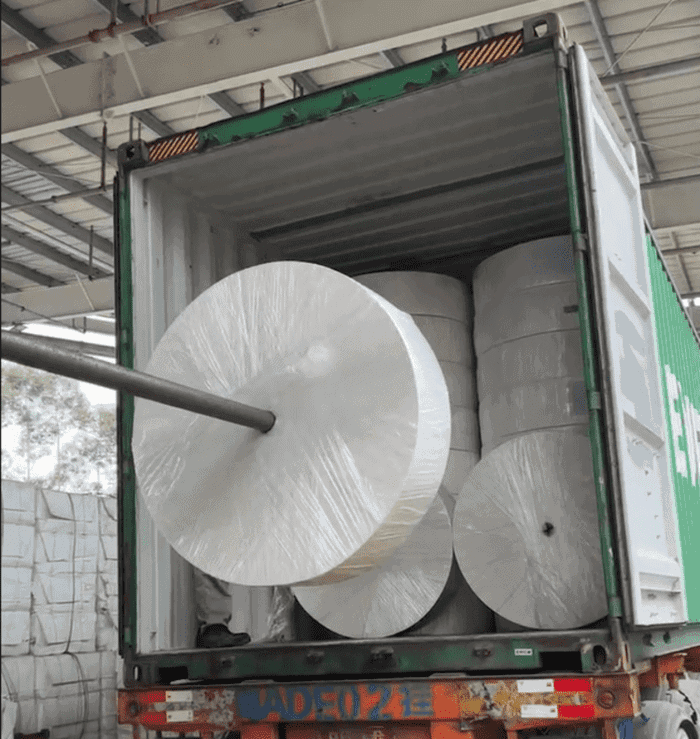
Roll width has the most direct impact on how many rolls fit side by side inside a shipping container. Common roll widths in the tissue converting industry range from as narrow as 1,000 mm up to 2,850 mm or more, with many standard widths in between such as 1,250 mm, 1,600 mm, 1,880 mm, 2,100 mm, and 2,400 mm.
The internal width of a standard 40-foot container is approximately 2,340 mm. This means:
- A 2,850 mm wide roll cannot stand upright — it must be loaded on its side, which requires careful planning
- A 1,150 mm wide roll allows two rolls side by side (2 x 1,150 mm = 2,300 mm) with minimal clearance
- A 1,000 mm wide roll allows two rolls per row with more breathing room
The interaction between roll width, container internal dimensions, and stacking height determines the total number of rolls per container. A change in roll width from 1,250 mm to 2,100 mm can reduce the number of rolls per container by 30–50%, even if everything else stays the same. This is why roll width is as important as GSM and ply count when calculating a shipment.
4. The Container Math: Why All Three Variables Work Together
To illustrate why all three variables must be considered simultaneously, let us walk through two realistic order scenarios using a standard 40-foot container. The internal dimensions of a standard 40-foot high-cube container are approximately:
| Dimension | Measurement |
| Internal Length | ~11,998 mm (approx. 12 meters) |
| Internal Width | ~2,340 mm |
| Internal Height | ~2,655 mm (high-cube) |
| Maximum Payload | ~26,000 – 28,000 kg |
Our standard jumbo roll diameter is 1,150 mm. With that fixed, here is how the three variables create completely different loading results:
| Parameter | Scenario A (Lightweight) | Scenario B (Heavy Spec) |
| GSM | 14 gsm | 28 gsm |
| Ply Count | 1-ply | 2-ply |
| Roll Width | 1,880 mm | 2,850 mm |
| Rolls per Row (side by side) | 1 roll | 1 roll |
| Rows along container length | ~6 rows | ~4 rows |
| Stacking height | 2 high | 2 high |
| Total Rolls | ~12 rolls | ~8 rolls |
| Estimated Weight per Roll | ~450 kg | ~1,200 kg |
| Total Estimated Weight | ~5.4 metric tons | ~9.6 metric tons |
| Limiting Factor | Container volume | Container weight |
Notice that not only does the roll count change significantly between scenarios, but the total tonnage per container changes even more dramatically — from roughly 5 to nearly 10 metric tons. This affects your freight cost per ton, your order frequency, your inventory planning, and your total landed cost per unit.
A supplier who tells you “a 40-foot container holds about 20 tons” without knowing your spec is not helping you — they are giving you a number that may be off by a factor of two or more in either direction.
5. What Happens When Deatail Specifications Are Not Provided?
When buyers request quotes without providing these three specifications, several problems can arise — all of which cost time and money:
Risk 1: Incorrect Freight Budgeting
If you budget your shipping costs based on a generic “tons per container” estimate and then discover your actual spec loads at a much lower or higher tonnage, your landed cost calculations will be wrong. This is especially painful when you are preparing customer quotes or import budgets before placing your order.
Risk 2: Production Line Disruptions
If you under-order because you assumed more tonnage per container than your spec actually allows, you may run short of raw material before your next shipment arrives. For tissue converters, a production line stoppage is extremely costly — both in lost output and in labor downtime.
Risk 3: Receiving the Wrong Product
Without confirmed specifications, a supplier may fill a vague order with whatever stock is closest in size — which may not be suitable for your converting equipment or your end product requirements. Tissue converting machines are calibrated to specific GSM ranges and roll widths. Loading the wrong tissue jumbo roll can damage equipment and result in unusable finished product.
Risk 4: Difficulty Comparing Supplier Quotes
If you send an unspecified inquiry to multiple suppliers and each one makes different assumptions about your GSM, ply, and width, you will receive quotes that are completely incomparable. One supplier may be quoting on 14 gsm 1-ply while another assumes 22 gsm 2-ply. Any price comparison you make between those quotes will be meaningless.
6. How to Prepare Before Requesting a Tissue Jumbo Roll Quote
The good news is that preparing an accurate, quotable inquiry takes very little extra effort once you know what information is needed. Before contacting any tissue jumbo roll supplier, have the following details ready:
| BUYER’S PRE-INQUIRY CHECKLIST ✔ Target GSM (paper weight) — e.g., 14 gsm, 17 gsm, 22 gsm ✔ Number of plies — 1-ply, 2-ply, 3-ply, etc. ✔ Roll width(s) required — in millimeters ✔ Container type — 20-foot or 40-foot (standard or high-cube) ✔ Destination port — for accurate freight calculation
Optional but helpful: • Core inner diameter (e.g., 76 mm or 152 mm) • Roll hardness preference (soft / medium / hard wind) • Raw material preference (100% virgin wood pulp / recycled / mixed) • Moisture content tolerance • Any relevant certifications required (FSC, ISO, etc.) |
If you are a first-time buyer or are still in the process of finalizing your product requirements, do not worry. A good supplier — like Yuanhua Paper — will guide you through the specification selection process based on your intended end-product and converting equipment. Simply share as much as you know, and we will help you fill in the gaps.
7. How Yuanhua Paper Supports Your Specification Process
At Yuanhua Paper, we manufacture tissue jumbo rolls across a wide range of specifications, and we work with importers, distributors, and tissue converters across more than 30 countries. We understand that not every buyer arrives with a finalized spec sheet — and that is completely normal, especially for businesses that are new to sourcing tissue jumbo rolls from China.
Here is what we offer to help you get to an accurate, competitive quote as quickly as possible:
- Free specification consultation
Tell us about your end product (toilet paper, facial tissue, napkins, etc.) and your converting equipment make and model if known. We will recommend the appropriate GSM, ply count, and roll width for your application.
- Container loading plan
Once your specifications are confirmed, we will provide a detailed container loading plan showing exact roll count, estimated total weight, and loading configuration — before you commit to your order.
- Full specification range
Our production capabilities cover 12–42 gsm, 1–5 ply, and a wide range of roll widths, all using 100% virgin wood pulp. This gives us the flexibility to meet diverse market requirements from economy-grade to premium tissue.
- Transparent pricing
Because we calculate our prices based on confirmed specifications, our quotes are accurate and all-inclusive. There are no surprises after you confirm your order.
To get started, simply contact us with your specification details:
| Detail | Information |
| Company | Yuanhua Paper |
| Phone / WhatsApp | +86 133 7774 0659 |
| Products | Tissue Jumbo Rolls — Toilet Paper, Facial Tissue, Napkins, Bottom-Pull Facial Tissue |
| Raw Material | 100% Virgin Wood Pulp |
| GSM Range | 12 – 42 gsm |
| Ply Options | 1 – 5 ply |
8. Conclusion: Better Specifications Mean Better Business
The next time a tissue jumbo roll supplier responds to your inquiry with “Could you please provide your GSM, ply count, and roll width?” — know that this is not a delay tactic or an unnecessary complication. It is the responsible, professional way to ensure that the quote you receive is accurate, comparable, and genuinely useful for your purchasing decision.
To summarize what we have covered in this article:
- GSM (paper weight) determines how heavy each roll is, directly impacting total tonnage per container and freight cost per unit.
- Ply count multiplies the weight and density of every roll, dramatically affecting how many rolls fit within the payload limit of a container.
- Roll width determines the physical footprint of each roll and how many fit side by side in the container’s fixed internal width.
- All three variables interact with the fixed container dimensions to determine the final roll count and total weight — making it impossible to quote accurately without all three.
Buyers who provide clear specifications get faster quotes, more accurate freight estimates, fewer order errors, and stronger long-term supplier relationships. It is a small investment in preparation that pays off every time you place an order.

We hope this guide has been helpful. If you have any questions about specifications, converting applications, or would like to request a quote, please do not hesitate to contact Yuanhua Paper. We look forward to being your trusted tissue jumbo roll partner.
— Yuanhua Paper | Professional Tissue Jumbo Roll Manufacturer —
+86 18318257726 | 100% Virgin Wood Pulp | 12–42 GSM | 1–5 Ply
